
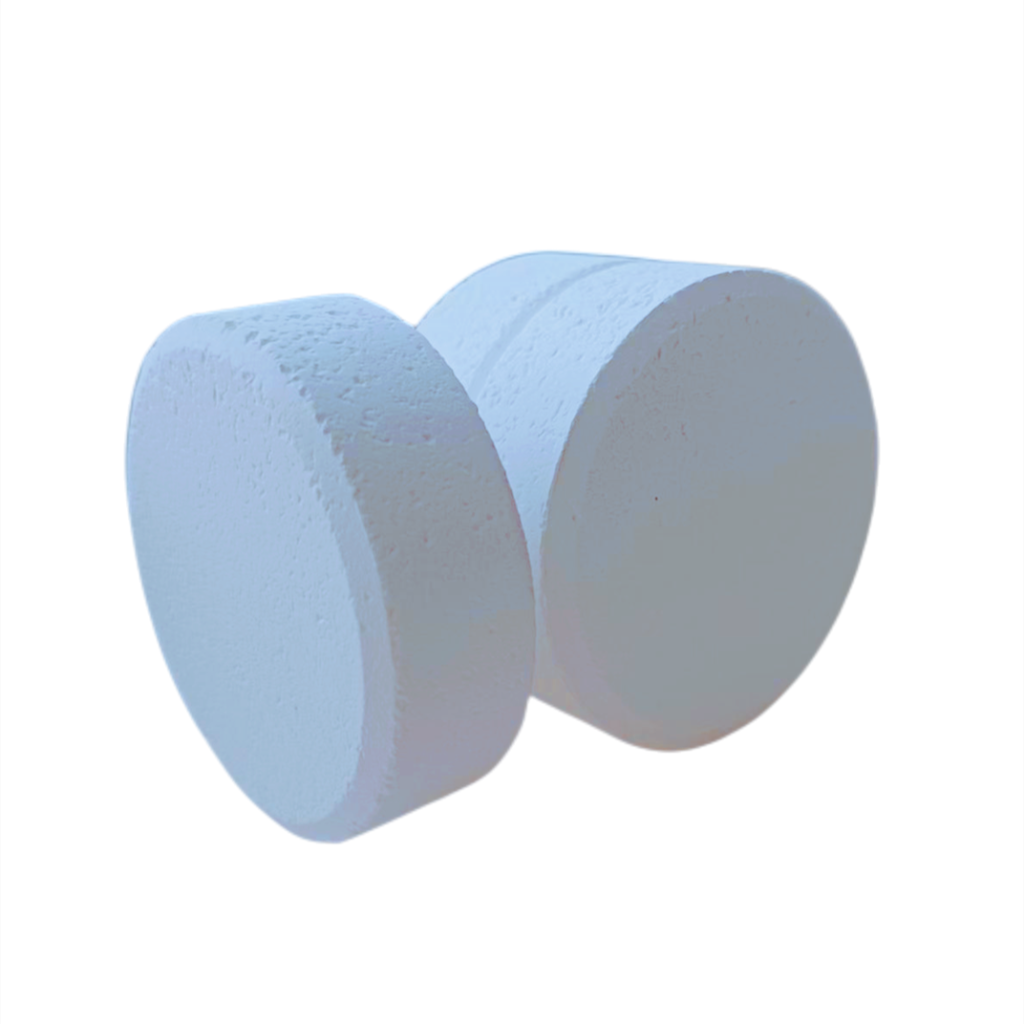
When purchasing 3 inch chlorine tablets, buyers often pay attention to available chlorine content, tablet weight, dimensions, and price. However, there is another important product characteristic that deserves attention: tablet hardness.
Tablet hardness affects how well a chlorine tablet maintains its physical structure during handling, packaging, transportation, and use. For swimming pool chlorine tablet manufacturers, controlling hardness is an important part of producing consistent products. But does a harder tablet always mean better quality? Not necessarily. The ideal hardness should balance physical strength with the product’s intended dissolution characteristics.
Tablet Hardness Helps Maintain Product Shape
Three-inch chlorine tablets are commonly purchased in bulk for residential and commercial swimming pool applications. During production, packaging, and transportation, tablets may experience pressure, vibration, and handling impacts.
If a tablet is too soft, it may be more likely to chip, crack, or break. Damaged tablets can create packaging problems and make products less convenient for distributors and end users.
Appropriate tablet hardness helps 3 inch pool chlorine tablets maintain their shape and dimensions. This is particularly important for manufacturers supplying large quantities of chlorine tablets to wholesalers and international customers.
However, hardness should be evaluated together with other physical properties rather than treated as the only measure of product quality.
It Can Affect Packaging and Transportation
Packaging and transportation are important considerations for bulk 3 inch chlorine tablets. Products may travel long distances before reaching distributors, swimming pool retailers, or commercial customers.
During loading, unloading, and transportation, excessive movement or external pressure can place stress on individual tablets. If the tablets have insufficient physical strength, breakage and powder formation may become more likely.
Suitable hardness can help reduce physical damage under normal handling conditions. It also supports better product presentation when customers open the packaging.
For chlorine tablet manufacturers, quality control should therefore include appropriate physical inspections and packaging evaluations. Buyers should also check whether the packaging is suitable for the intended shipping and storage conditions.
Hardness Is Related to the Tablet Manufacturing Process
The hardness of 3 inch chlorine tablets is influenced by several manufacturing factors.
Compression conditions: The pressure and settings used during tablet compression can affect the density and physical strength of the finished tablets.
- Raw material characteristics: Particle size, material properties, and formulation compatibility may influence how ingredients form a compact tablet.
- Moisture control: Some chlorine compounds are sensitive to moisture. Proper handling and storage of raw materials are important for maintaining product stability during manufacturing.
- Production consistency: Differences in equipment settings or material characteristics can lead to variations between production batches.
A professional 3 inch chlorine tablet manufacturer needs to manage these factors through suitable production procedures and quality inspections. Consistent manufacturing helps buyers receive products with more predictable physical characteristics.
Does Higher Hardness Always Mean Better Chlorine Tablets?
It is easy to assume that harder chlorine tablets are always better because they are less likely to break. However, tablet hardness is only one part of overall product performance.
The tablet formulation, intended application, and dissolution characteristics must also be considered. Excessive compression may influence how a tablet interacts with circulating water, depending on its formulation and manufacturing process.
For this reason, manufacturers should not focus on achieving the highest possible hardness. Instead, they should establish suitable physical specifications that balance tablet integrity with the intended product performance.
For pool operators, the actual dissolution rate also depends on water temperature, circulation, feeder settings, and other operating conditions. A tablet’s hardness alone cannot determine how quickly it dissolves.
What Should Buyers Check When Purchasing 3 Inch Chlorine Tablets?
For wholesalers, distributors, and commercial pool chemical buyers, evaluating product quality requires more than checking the appearance of a single tablet.
Before choosing a 3 inch chlorine tablets supplier, buyers can consider the following points:
- Tablet dimensions and weight: Check whether the product specifications meet the intended requirements.
- Physical integrity: Look for obvious cracks, excessive chipping, or unusual powder formation.
- Available chlorine content: Confirm that the stated chemical specifications are supported by appropriate product documentation.
- Batch consistency: Ask how the manufacturer monitors product quality across different production batches.
- Packaging suitability: Check whether the packaging can protect the tablets during handling and transportation.
- Supply reliability: Consider production capacity, order quantities, and delivery arrangements.
These checks can help buyers compare different 3 inch chlorine tablets manufacturers and make more informed purchasing decisions.
Why Manufacturing Quality Matters to Long-Term Buyers
For businesses purchasing chlorine tablets regularly, product consistency can influence customer satisfaction and inventory management.
A reliable manufacturer should pay attention to raw material control, compression procedures, finished-product inspection, and packaging quality. These production details help maintain consistent product specifications and reduce avoidable quality variations.
QC Industry supplies swimming pool chlorine tablets and water treatment chemicals to international customers. For buyers sourcing 3 inch chlorine tablets in bulk, discussing tablet specifications, packaging requirements, and quality control procedures with the manufacturer can help establish clear expectations before ordering.
Conclusion
Tablet hardness plays an important role in the physical quality of 3 inch chlorine tablets. It influences product integrity during handling, packaging, and transportation, while also reflecting aspects of the manufacturing process.
However, harder does not automatically mean better. A well-made chlorine tablet should balance physical strength, product consistency, and its intended dissolution performance.
For distributors and wholesale buyers, choosing a manufacturer that pays attention to tablet specifications and production quality is an important step toward building a dependable long-term supply relationship.